
Pool-IQ for Properties
Water-test logs your health inspector will accept, from any phone.
One place for every pool you're responsible for. Your team scans a strip or types the readings; Pool-IQ checks them against the health code, alerts you the minute water goes out of range or a test is missed, and prints the log when someone asks for it.
No card needed to start. Set up in ten minutes.
Built for the people who answer for the water
Hotels & resorts
Several pools and spas, hourly tests, an inspector who wants the log at the desk.
Apartments & HOAs
A community pool and a manager who is not a pool person. Clear alerts, no chemistry degree.
Gyms & clubs
Indoor lap pools and spas with their own stabilizer and sanitizer limits.
Municipal & schools
Public pools where a missed test is a closure and a record request.
Pool service companies
Every customer's commercial pool in one account; techs log from the truck, clients get the report.
How it works
1. Add properties and pools
Each pool gets its type, sanitizer, volume and a test schedule (every 2 hours, daily, whatever your code says).
2. The team logs tests from any phone
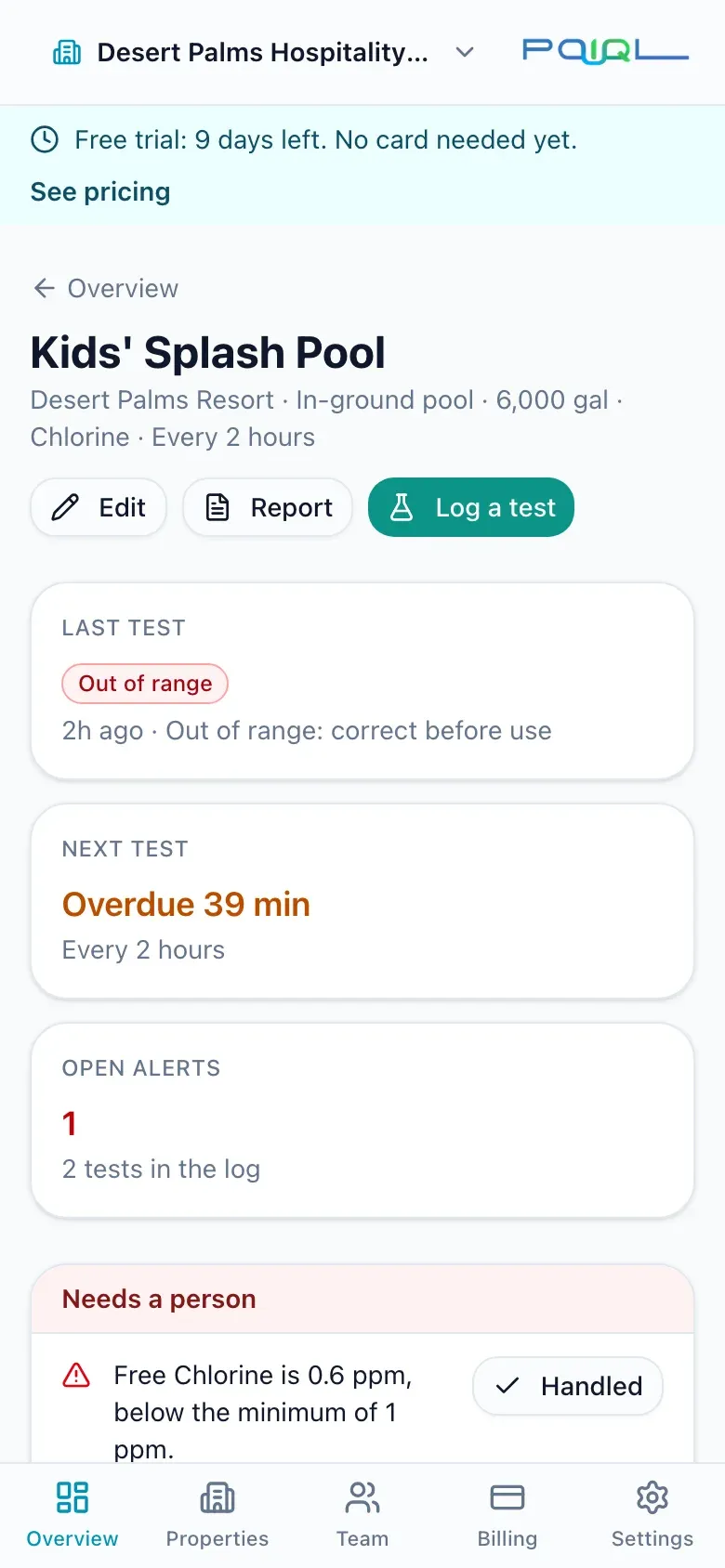
Scan a test strip with the camera, count the drops of a Taylor kit, or type the readings from any kit. Techs open the Today list, see what's due, and log in two taps.
3. Alerts when something's wrong
Water outside health-code limits, or a test that's overdue, emails the owners and managers right away.
4. Print the log when asked
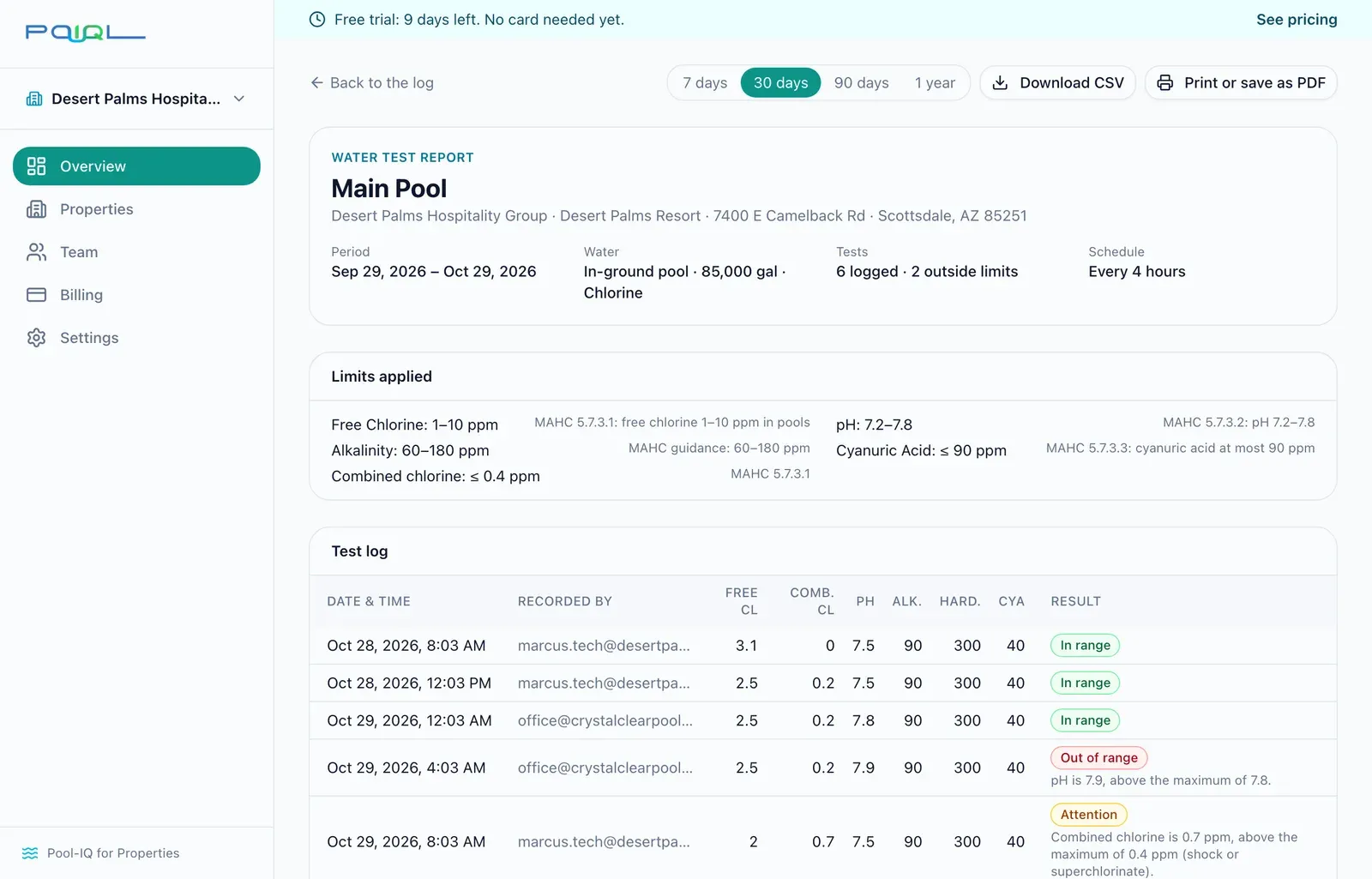
A dated report per pool or per property for any period, with the limits applied and who logged each test. Print it, save it as a PDF, or download the tests as a CSV.
What the inspector sees, and what the tech sees
What you get
Your state's health code, not a generic one
The property's address picks the code: Arizona (Maricopa County), California, Florida, Georgia, Illinois, Nevada, New Jersey, New York, North Carolina and Texas have their own limits; everywhere else the CDC Model Aquatic Health Code applies. Every report names the rule it followed.
Test schedules that watch themselves
Set how often each pool must be tested. Overdue pools show up on the overview and in a daily email.
Roles for the whole team
Owners handle billing, managers handle pools and people, techs log tests. Members are free.
A record that survives staff changes
Tests belong to the organization, not the tech's account. When someone leaves, the log stays complete with their name on it.
Dosing, not just a verdict
The same chemistry engine that guides homeowners tells your tech what to add for this pool's volume, and when to retest.
Works with the kit you have
Pool-IQ reads standard 6- and 7-way strips, turns Taylor K-2006 drop counts into ppm, takes typed readings from any photometer, and imports your existing log from a spreadsheet or a LaMotte export.
Upkeep that gets done
Baskets, backwash, brushing, drain covers, rescue gear: each task on its own schedule, on Today when it's due, and logged with who did it, so the inspector sees the record and you see what was skipped.
Chemicals, stock and cost
Keep what's on the shelf at each property with a reorder level and a unit cost. Techs record what each pool used; managers see the month's spend and get a nudge on Today before the cal-hypo runs out.
Who tested, where, and when
The Team page shows who is on site now and each member's last test; an activity report lists tests by person and day for the manager, or the inspector who asks who was on duty.
Simple pricing: per pool, not per person
$15 per active pool a month. Invite as many managers and techs as you like and log as often as your code requires. Archive a pool for the off-season and it stops being billed.
- 14-day free trial, no card needed
- Unlimited team members and tests
- Health-code checks, alerts and overdue reminders
- Printable reports and CSV downloads for any period
- Cancel any time; your logs stay
Per pool
$15/month
A resort with three pools and a spa pays $60 a month. A single HOA pool pays $15.
Start free trialBilling starts only when you subscribe after the trial.
Questions operators ask
- Which limits does it use?
- The public-pool code at the property's address. Ten jurisdictions have their own limits built in, read from the rule text and cited on every report: Maricopa County in Arizona, California, Florida, Georgia, Illinois, Nevada, New Jersey, New York, North Carolina and Texas. Elsewhere it's the CDC Model Aquatic Health Code, which most codes adopt or resemble. The limits applied, with the rule and the date it was checked, are printed on every report; confirm them with your inspector, and tell us if your state is missing.
- Does this replace the paper log?
- For most jurisdictions a dated, attributed electronic record is accepted; the report prints as a PDF with the date, the person who logged each test, the readings and the limits. Check with your local health department if your code names a specific form.
- What do technicians need?
- A phone and a free Pool-IQ account. You invite them by email; they log tests for your pools and see alerts. They can't change billing or remove people.
- What does it cost?
- $15 per active pool a month, with unlimited team members and tests. The first 14 days are free and no card is needed to start. Archive a pool for the off-season and it stops being billed; its log is kept.
- What happens if we stop paying?
- Logging pauses. Nothing is deleted: you can still open and print every log, and subscribing again turns logging back on.
- Is there an app?
- Pool-IQ runs in the phone's browser, so there's nothing to install on staff phones.
Start logging today
Set up your first property in minutes; invite the team when you're ready.